Education & Research
Return to the full category guide.

At a glance
| Option | Primary consideration | Important limitation |
|---|---|---|
| Dermal fillers | Product-specific approved indications | Not FDA-approved for breast enlargement |
| PRP | Evidence for the particular intended use | Should not be promoted as proven breast enlargement |
| Threads & mono threads | Product-specific aesthetic indications | Not established substitutes for breast augmentation |
| Sculptra / biostimulators | Product-specific authorised uses | Do not assume suitability for breast-volume enhancement |
| Stem-cell approaches | Evidence and regulatory status of the exact product | Many marketed regenerative uses remain unapproved or investigational |
| Silicone breast implants | Surgical increase in breast volume | Surgery, implant-related risks and potential future procedures |
| Fat transfer | Uses the patient’s own fat for augmentation | Variable fat retention and a limited, individualised result |
Compare the concepts
Each approach acts differently: implants add volume, fat transfer adds your own tissue, fillers add temporary material, and a lift changes shape rather than volume.
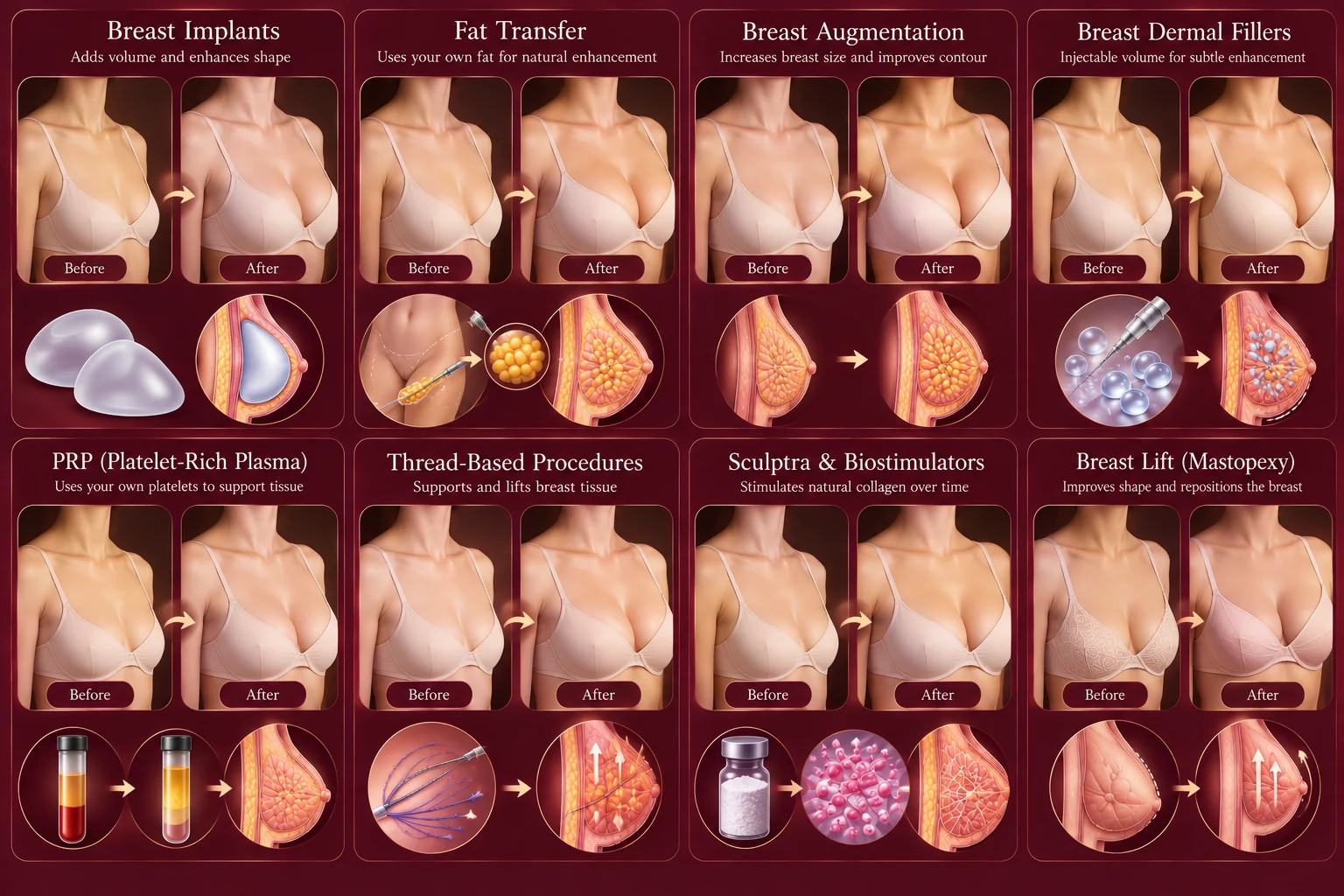
Choosing between options is not a matter of finding the “safest” label. It requires understanding your goals, your anatomy and health, the evidence for each intended effect, and the risks you are prepared to accept. A consultation with an appropriately qualified clinician is the appropriate way to reach an individualised view.
Not every treatment marketed as “non-surgical breast enlargement” has demonstrated a reliable increase in breast volume. Surgical and non-surgical approaches differ in their intended effect, their evidence base, their risks and their recovery requirements. Treating them as interchangeable can lead to unrealistic expectations.
Surgical augmentation is designed to increase breast volume or change breast shape. Some non-surgical treatments target skin quality or provide a different aesthetic effect rather than a meaningful increase in volume. Others are marketed for volume but lack robust supporting evidence for that specific use.
The evidence base differs sharply. Dermal fillers are not approved for breast enlargement, and regulators advise against using them for this purpose. Regenerative and biostimulatory products require careful scrutiny of their evidence and regulatory status.
“Non-surgical” does not mean risk-free. Any procedure carries some risk, and the consequences of complications can differ substantially between approaches. Surgery carries surgical and implant-related risks and may involve future procedures.
The appropriate option depends on your health, anatomy, expectations and risk tolerance, and on the evidence for the intended treatment. That assessment should be made by an appropriately qualified clinician, not from advertising alone.
Continue reading
Return to the full category guide.
Candidacy, risks and when to seek medical help.
Study findings, limitations and original publications.