Treatments at a glance
A plain overview of fillers, threads, PRP, biostimulators and regenerative approaches, what each is designed for and the main limitation of each.

For the individual evidence guides, explore the Non-Surgical Breast Enlargement section.
Treatments marketed as “non-surgical breast enlargement” are not a single category. They include injectable fillers, platelet-rich plasma (PRP), thread-based procedures and collagen-stimulating biostimulators. Each has a different intended effect, a different evidence base and a different regulatory position.
Crucially, being non-surgical does not automatically mean a treatment is safe, and not every treatment marketed for this purpose has been demonstrated to reliably increase breast volume. This section is written to help you understand those distinctions before any clinical consultation.
Dermal fillers are not approved for breast enlargement, and the FDA advises against using fillers or other injectable fillers to increase breast size because of potentially serious complications. Regenerative and biostimulatory products require careful scrutiny of their evidence and regulatory status before any claim of benefit is accepted.
Assessing any non-surgical claim
Any advertised non-surgical breast treatment should withstand these questions before you consider it.

Ask for the precise product name, its approved indications and whether breast use is authorised in your jurisdiction.
Facial approval does not imply approval for injection into the breasts. Products and permitted uses vary by country.
Distinguish marketing claims from peer-reviewed evidence for the specific procedure being offered.
Suitability depends on the precise product, intended use, clinician competence and applicable regulation.
Ask about infection, pain, tissue damage, nodules, asymmetry and how complications would be managed.
Consider evidence-based alternatives for increasing breast volume, including surgical options where relevant.
At a glance
| Option | Primary consideration | Important limitation |
|---|---|---|
| Dermal fillers | Product-specific approved indications | Not FDA-approved for breast enlargement |
| PRP | Evidence for the particular intended use | Should not be promoted as proven breast enlargement |
| Threads & mono threads | Product-specific aesthetic indications | Not established substitutes for breast augmentation |
| Sculptra / biostimulators | Product-specific authorised uses | Do not assume suitability for breast-volume enhancement |
| Stem-cell approaches | Evidence and regulatory status of the exact product | Many marketed regenerative uses remain unapproved or investigational |
This table covers non-surgical options only. For a side-by-side view including surgical routes (implants and fat transfer), see the full treatment comparison. It should not be read to suggest that a non-surgical procedure is automatically safer than surgery.
Non-surgical and adjunct options
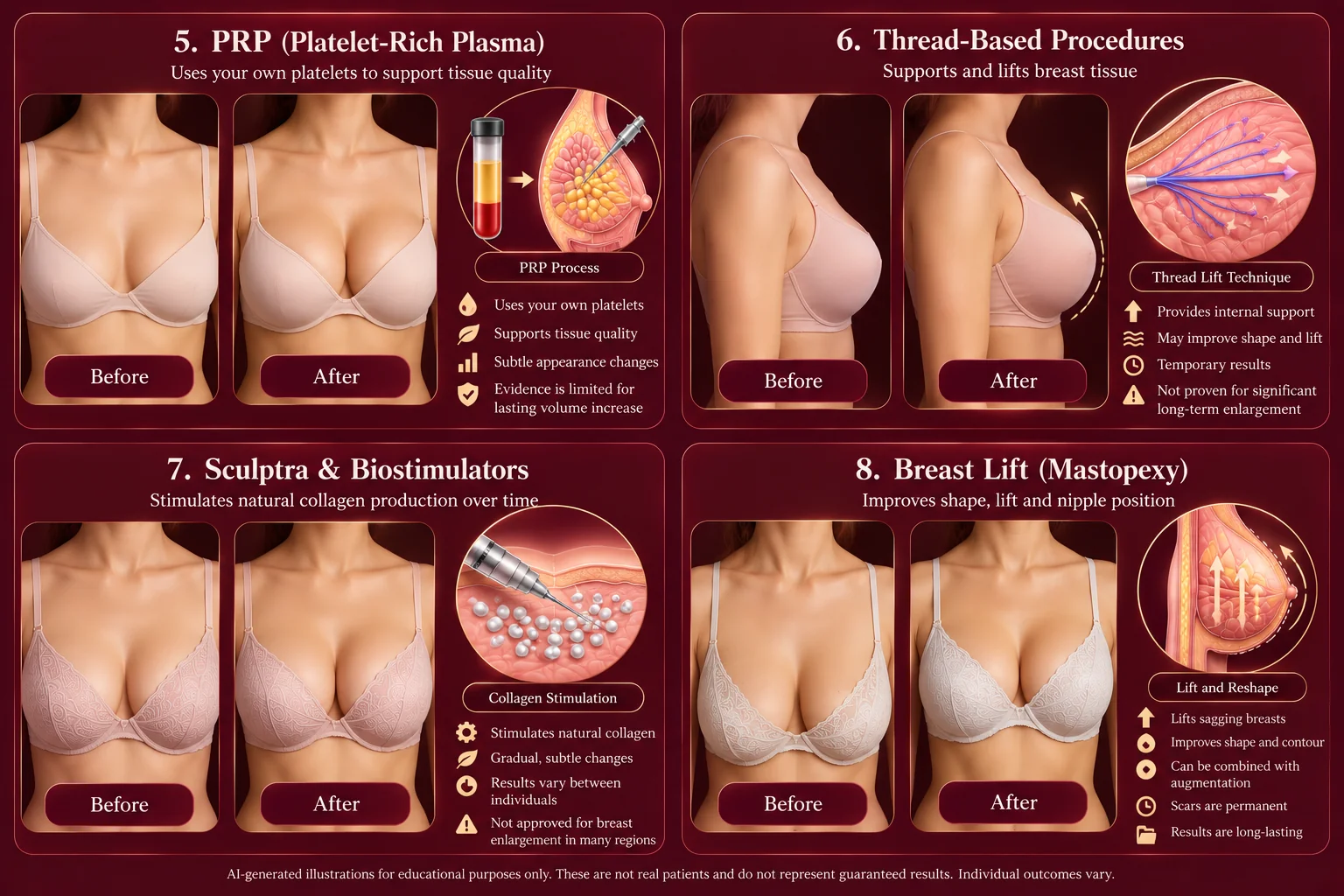
These options are often marketed as alternatives to augmentation. The illustration summarises what each claims; the sections below explain where the evidence is limited.
Questions
A properly fitted bra, padding, clothing choices and posture change the look immediately and carry no medical risk — but they change appearance, not breast tissue. For a method-by-method verdict on every popular approach, read the evidence guide.
No. The term describes an area of ongoing research, not proof of effectiveness, approval or suitability for breast enhancement. Products and permitted uses vary by jurisdiction.
Each treatment page on this website answers its own specific questions, and the most common cross-cutting questions are consolidated on the main FAQs page, with links into the detailed guides.
In this guide
Five focused pages on the questions people ask most about this option.
A plain overview of fillers, threads, PRP, biostimulators and regenerative approaches, what each is designed for and the main limitation of each.
Why some non-surgical breast treatments may change how the breasts look briefly without adding lasting volume, and how to avoid being misled.
A practical guide to judging studies, reviews and testimonials on non-surgical breast enlargement, including common weaknesses.
What it means for a product to be approved, cleared or used off-label, and why it matters for non-surgical breast treatments.
A practical checklist of questions to ask a clinic offering non-surgical breast treatments, and the warning signs that should make you pause.
Continue reading
Return to the full category guide.
Candidacy, risks and when to seek medical help.
Study findings, limitations and original publications.