
Augmentation candidacy
Understand who may be suitable for breast augmentation, who may need to wait, and the health and expectation factors a surgeon assesses.

It may be considered by people seeking greater fullness, a change in proportions, or restoration of volume following pregnancy or weight change. Treatment planning should account for anatomy, existing breast tissue, skin characteristics, general health, lifestyle, expectations and the individual’s willingness to accept surgical risks and future follow-up.
What patients should understand
The difference between implant-based augmentation and fat transfer, and what each can achieve.
Why a qualified and appropriately credentialed plastic surgeon should lead the plan.
The need for preoperative assessment and informed consent.
Recovery requirements, scar management and follow-up.
Potential complications and the possibility that revision surgery is needed.
The figures and lists below summarise patient information published by the American Society of Plastic Surgeons (ASPS), the largest association of board-certified plastic surgeons in the United States. They are reproduced here for education and context. ASPS guidance reflects United States practice and regulation and does not replace assessment by a suitably qualified clinician in your own jurisdiction.
ASPS patient information
| Goal | What ASPS patient information says |
|---|---|
| Increase fullness and projection | Breast implants or fat transfer can increase the size and projection of the breasts. |
| Improve balance and proportion | Augmentation can improve the balance between breast and hip contours. |
| Support body image | ASPS notes the procedure may enhance self-image and self-confidence. |
| Breast reconstruction | Implants may also be used for breast reconstruction after mastectomy or injury. |
| Severe drooping | Augmentation alone does not correct severely drooping breasts; a breast lift may be needed, at the same time or as a separate operation. |
Options at a glance
The four approaches shown here add volume in different ways — and differ in evidence, duration and risk.
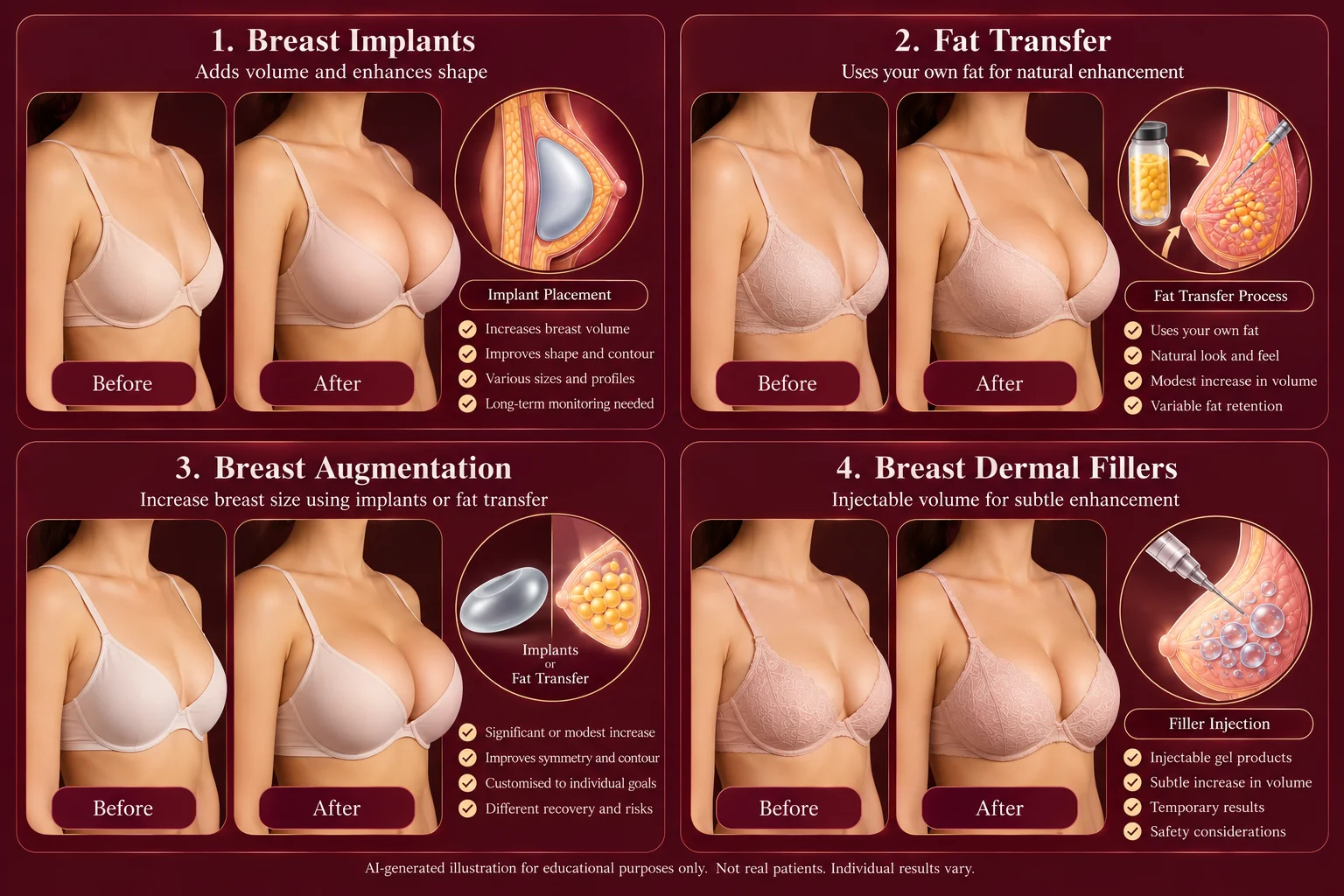
ASPS patient information
ASPS describes the operation in five broad stages.
Intravenous sedation or general anaesthesia is used, so the procedure is comfortable throughout.
Peri-areolar, inframammary fold or axillary incisions are the usual routes; ASPS notes that the belly-button approach carries a higher complication rate.
The implant is placed either under the pectoral muscle (submuscular) or behind the breast tissue over the muscle (subglandular).
Layered sutures close the tissue, with sutures, skin adhesive or surgical tape on the skin. Scars fade over time and are affected by genetics, nicotine and infection.
Results are visible immediately, with the final shape settling as swelling resolves.
ASPS patient information
| Implant | What ASPS patient information says |
|---|---|
| Saline | Sterile salt water; collapses and is absorbed or expelled if the shell leaks; uniform shape and firmness; FDA-approved from age 18. |
| Structured saline | Salt water with an internal structure for a more natural feel. |
| Silicone gel | Gel feels more like natural breast tissue; does not collapse if it leaks; regular ultrasound or MRI screening is advised; FDA-approved from age 22. |
| Form-stable (“gummy bear”) | Keeps its shape even if the shell breaks; firmer and thicker; a shaped version gives more bottom projection but can look unusual if it rotates; requires a longer incision. |
| Round | Generally a fuller look; higher profiles add more projection; less concern about rotation. |
| Smooth | Softest feel and natural movement, but rippling may be felt or seen. |
| Textured | Tissue adheres to the surface so it is less likely to move and may reduce capsular contracture, but textured surfaces are where BIA-ALCL occurs most often. |
ASPS lists the following possible risks of breast augmentation surgery, discussed fully before consent:
For silicone implants, the FDA recommends screening with MRI or ultrasound five to six years after placement and every two to three years thereafter. Risk factors include pregnancy, weight change and the menopause. Routine examinations help confirm that an implant is intact, because a ruptured implant sometimes causes no symptoms.
ASPS patient information
| Procedure | ASPS average surgeon fee |
|---|---|
| Breast augmentation with implants | $4,875 |
| Breast augmentation with fat grafting | $5,719 |
ASPS averages cover the surgeon’s fee only and exclude anaesthesia, operating-room facilities, medical tests, post-surgery garments and prescriptions. Most health insurance plans do not cover cosmetic breast augmentation or a later revision.
ASPS 2025 statistics
| Measure | ASPS 2025 data |
|---|---|
| Year-on-year change | Breast augmentation rose about 11% in 2025. |
| Rank | Second most common cosmetic surgical procedure, behind liposuction. |
| Among women | Narrowly the most popular cosmetic procedure, ahead of liposuction. |
| By age | Favourite procedure for ages 36–45; gains across ages 26–65; the 66+ group grew fastest overall (+24%). |
| Preference | A shift towards smaller, more proportionate implants was noted. |
| Related trends | Breast lifts rose about 8% and breast reductions about 7%; 82% of member surgeons reported GLP-1-related consultation requests. |
Figures are from the ASPS 2025 plastic surgery statistics and describe the United States, so they do not represent Indian or regional practice.
Summarised from ASPS patient information and statistics pages:
The clinical background on this page is also drawn from the peer-reviewed StatPearls review Breast Augmentation (Bookshelf ID NBK482206, PMID 29489168), published by the US National Library of Medicine. Its sections on indications, contraindications, implant choices, placement, incisions, recovery, complications and outcomes are indexed in our NCBI Bookshelf breast augmentation library, with links to each section of the original.
Read the full review on ncbi.nlm.nih.gov — it is free to read, and it describes United States practice and regulation at the time of writing.
Scars are an expected part of breast augmentation surgery, and where they sit is governed mainly by the incision used to create the implant pocket. Their final appearance depends on incision choice, skin type, genetics, tension on the wound and aftercare. The sections below describe the usual incision options, how scars typically mature and which general measures support healing. Outcomes, risks and suitability vary between individuals, and an in-person medical assessment is required before any treatment decision.
Surgeons reach the breast and the implant pocket through a small number of standard routes. The choice balances surgical access, the implant type and implant placement, the surgeon's training, and the patient's anatomy and preferences. Incisions are usually planned so that resulting lines fall within natural skin folds or along the border between skin and areolar pigment, where they are simpler to conceal in ordinary clothing. No incision leaves skin without a mark; planning aims to keep lines discreet rather than absent.
The inframammary incision sits in the crease beneath the breast. It provides direct access to the pocket and is used for both silicone and saline devices, as well as for many revision procedures. The line is hidden within the fold when standing, although its visibility changes with posture and clothing. Where the fold is shallow, or where the two sides differ, the surgeon plans the crease position carefully so the scar does not sit too high or too low. Heavier or larger breast implant sizes can place more tension on this line during healing.
A periareolar incision follows the lower border of the areola, where darker and lighter pigment meet. It can be a reasonable option where that border is well defined. The route passes through breast tissue, and surgeons discuss possible implications for nipple sensation and breastfeeding in general terms at consultation. Scar visibility depends on how the line heals along the pigment boundary, and this varies with skin type and individual tendency to pigmentation change.
A transaxillary incision is placed within the armpit crease, so no scar appears on the breast skin itself. It is used with particular implant types and operative approaches and depends on the surgeon's training and the patient's anatomy. Because the working distance to the breast is longer, later surgery is not always possible through the same route, and some revisions require an additional incision. Consultation therefore covers these limitations alongside the position of the scar.
| Approach | Typical scar position | Points in favour | Points to discuss |
|---|
| Inframammary fold | Crease beneath the breast | Direct access; commonly used for primary and revision surgery | Line may be visible in some positions; fold position needs planning |
|---|---|---|---|
| Periareolar | Lower border of the areola | Pigment boundary can soften the line | Passes through breast tissue; healing varies by skin type |
| Transaxillary | Armpit crease | No scar on the breast skin | Technique dependent; later access can be limited |
Scar healing is usually described in overlapping phases rather than fixed stages. In the first weeks the line is commonly pink or red, slightly raised and firm to touch, and itching or tightness is frequent. Over the following months collagen remodels, and the scar typically becomes flatter, softer and paler. Maturation frequently continues for a year or longer, and some lines keep changing beyond that. These descriptions are indicative only; the pace and the final appearance vary widely between individuals.
Skin type and genetics influence the result. Darker skin tones may be more prone to pigmentation change, and some people form raised or keloid scarring whatever the incision used. The skin of the breast also carries tension, particularly with heavier devices, which can widen a line over many months. Terms such as hypertrophic and keloid scarring are explained in the site glossary, which may help when reading clinical letters.
Patients often ask what they will see at each stage. In the early weeks the line may look prominent and feel tight; by the third month it is commonly flatter though still coloured; through the second half of the first year it usually continues to soften. Some people find the scar most noticeable at three to six months and quieter afterwards, while for others change is slow and steady. Clinical photographs taken at follow-up help track progress objectively once memory of the earlier appearance has faded.
Most surgical teams provide written aftercare instructions, and protocols differ between clinics and between patients. Measures commonly discussed include the following, introduced at the stage of healing your surgeon advises.
Massage of mature incision lines is advised by some surgical teams and not others, so it should begin only when wounds are confirmed closed and comfortable. Firm pressure over unhealed skin, early underwire bras and adhesive products used too soon can irritate a healing line. If dressings or tapes are used, instructions on when to change or remove them should be followed exactly, and any skin reaction should be reported.
Several factors can work against neat healing, and many of them are modifiable before and after surgery.
These points sit alongside the general breast augmentation risks discussed during consent, and they are reviewed before surgery so that planning reflects individual circumstances.
Fat transfer breast augmentation avoids implant incisions on the breast in many cases, but small scars remain. Fat is harvested through liposuction access points, commonly on the abdomen, flanks or thighs, and these puncture marks mature like other scars. The marks are usually short, although their number and position depend on the areas treated. Donor areas can also change in contour, and access points may be visible on the skin of the breast where fat is injected. Sun protection, garment use and adherence to aftercare advice apply to donor sites as well as to the breast.
Small differences in scar position, length or width between the two sides are common and often settle as healing progresses. Lines may widen when tension is high, and some patients notice a scar more in certain positions than under clothing. Scar position can also shift slightly as swelling settles and the implant settles into its pocket, so a concern raised at two weeks is assessed differently from one raised at twelve months. Where a scar matures unfavourably, options such as silicone therapy, injections, laser treatment or surgical scar revision can be discussed; these are individualised and are usually considered after maturation is complete. Further breast surgery may reuse an existing line or require a new one, as outlined in breast implant revision. No revision can be promised to produce a particular scar appearance.
Contact the surgical team promptly if a scar or wound shows spreading redness, increasing warmth or pain, discharge, bleeding, opening of the wound, fever, or a rapidly thickening or painful raised scar. Sudden change in breast shape, a firm painful breast, or a scar that concerns you also warrants review, as does any worry that arises between scheduled visits. Early assessment is preferable to waiting when something feels wrong, and follow-up forms part of the pathway described in breast augmentation surgery patient information.
Useful questions include where scars would sit for your anatomy, which incision suits the planned implant and pocket, how the fold or areolar border is planned, what aftercare is provided, how follow-up is arranged, and how scars are managed if healing is slow. Marketing language implying that surgery can leave skin without marks should be treated with scepticism. This information is educational and is not a substitute for personal medical advice from a qualified clinician.
Scars do not disappear entirely. They usually soften, flatten and pale over many months to more than a year, but final appearance varies with skin type, genetics, incision site and healing conditions. Surgeons aim to place incisions where lines can be concealed rather than erased.
Noticeability depends on skin type, healing, clothing and individual preference rather than a single ranking of approaches. Inframammary, periareolar and transaxillary incisions each sit in different anatomical areas with different trade-offs. Suitability is assessed during an in-person consultation.
Early scars are often pink, raised or firm for the first weeks to months, then gradually flatten and fade. Maturation commonly continues for a year or longer, and the timeline varies between individuals. Follow-up review helps track healing.
Nicotine use, wound tension, infection, poor nutrition and delayed healing can all affect scar quality, and sun exposure can darken immature scars. Following post-operative instructions and attending follow-up supports healing. Individual variation remains important.
Questions
Recovery varies according to the procedure, surgical technique, individual healing and the clinician’s advice. Your surgeon will give you a personalised return-to-activity timeline.
No procedure can promise permanent results. Breast implants are not lifetime devices: additional operations may be needed and complications can occur. Fat transfer results depend on how much transferred fat survives.
Understand who may be suitable for breast augmentation, who may need to wait, and the health and expectation factors a surgeon assesses.

A plain-language walkthrough of breast augmentation, from the consultation and anaesthesia to the operation, recovery and follow-up.
Compare inframammary, periareolar and armpit incisions for breast augmentation, including scarring, visibility and practical considerations.
How to prepare for breast augmentation, covering medical checks, medicines, smoking, home preparation and what to arrange for recovery.
How breast augmentation results change from the first weeks to years later, including swelling, settling, ageing and weight change.
Continue reading
Return to the full category guide.
Candidacy, risks and when to seek medical help.
Study findings, limitations and original publications.