Education & Research
Return to the full category guide.

“Breast enlargement” describes two very different things. One is a change in the look of the breasts — a bra, padding, posture or clothing. The other is a change in the breast itself — more glandular or fatty tissue, or a device placed inside it. Confusing the two is the single most common reason people spend money on something that cannot work.
This page sets out the vocabulary, the biology and the framework used throughout the rest of the site, so that every treatment page and evidence verdict has a clear reference point.
The core distinction
A correctly fitted bra, padding, push-up styles, inserts, styling and posture change how the chest looks immediately. They carry no medical risk, are fully reversible, and do not alter breast tissue.
Fat transfer moves your own fat into the breast; implants place a prosthesis. Both are procedures with recovery, risk and cost. Only these routes add lasting volume without hormones.
The breast sits on the chest wall over the pectoral muscles. It contains glandular tissue (lobules and ducts that produce and carry milk), fibrous connective tissue that supports it, and fat. There is no muscle inside the breast — a point that explains why chest exercises firm the wall but do not enlarge the breast. Skin and suspensory ligaments give the breast its shape and are the structures that stretch with pregnancy, weight change and age.
Breast size is therefore determined by how much glandular and fatty tissue sits on the chest, plus the skin envelope around it. Nothing applied to the surface of the skin can grow the tissue underneath.
Breast development is driven mainly by hormones — above all oestrogen — during puberty, with further changes in pregnancy and breastfeeding. In adult life, breast volume mostly follows overall body fat, the hormonal cycle, pregnancy and age. The signal that builds breast tissue is internal and hormonal.
This is why the only known routes to more tissue are hormonal stimulation (a medical matter, not a cosmetic one), fat transfer (your own fat, moved by a surgeon), and implants (a prosthesis). Creams, pills, massage, suction cups and devices have no established mechanism for adding breast tissue at all.
At a glance
| Route | What it is | Adds lasting tissue? | Nature |
|---|---|---|---|
| Cosmetic | Bras, padding, styling, posture | No — changes appearance only | Free or low cost, reversible, no medical risk |
| Fat transfer | Your own fat moved by liposuction and injection | Yes — modest and variable | Minimally invasive procedure with real risks |
| Implants | A saline or silicone device placed surgically | Yes — predictable volume | Surgery with long-term monitoring and revision risk |
| Hormonal | Medically supervised hormone treatment | Yes, in principle | A medical treatment, not a cosmetic route; carries systemic risks |
Non-surgical injectables such as fillers, PRP and biostimulators do not belong on this list as reliable routes to lasting volume — see the evidence guide for why.
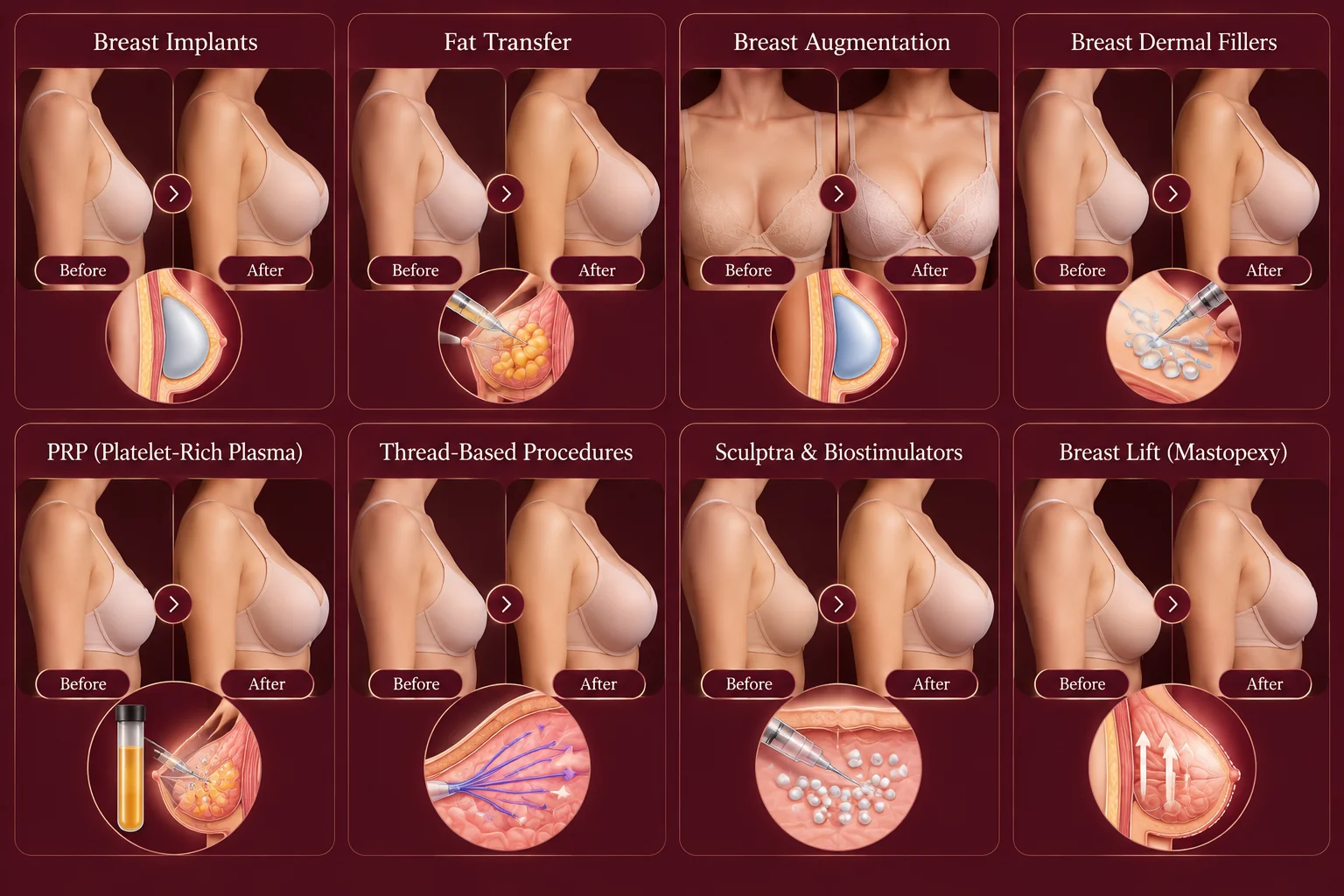
Visual overview
A quick map of the approaches discussed across this guide, from implants and fat transfer to injectables, threads and lift.
How to use this website
Work through the information at your own pace. No decision about your body should ever be rushed by advertising.

Read this page and the breast anatomy guide so that you can tell appearance changes from tissue changes.
Work through the non-surgical and surgical sections to understand intended effects, mechanisms and limitations.
Use the evidence guide and research libraries to see what is proven, what is unproven and what to avoid.
Review candidacy, contraindications, complications and the warning signs that need medical attention.
Take written questions to a registered, appropriately qualified professional and compare more than one opinion.
This page explains concepts for general education. It cannot account for your health, anatomy or circumstances, and it does not recommend any treatment. Decisions about breast enlargement should be made with a qualified, registered clinician after proper assessment.
Continue reading
Return to the full category guide.
Candidacy, risks and when to seek medical help.
Study findings, limitations and original publications.