Surgical Breast Enlargement
Return to the full category guide.
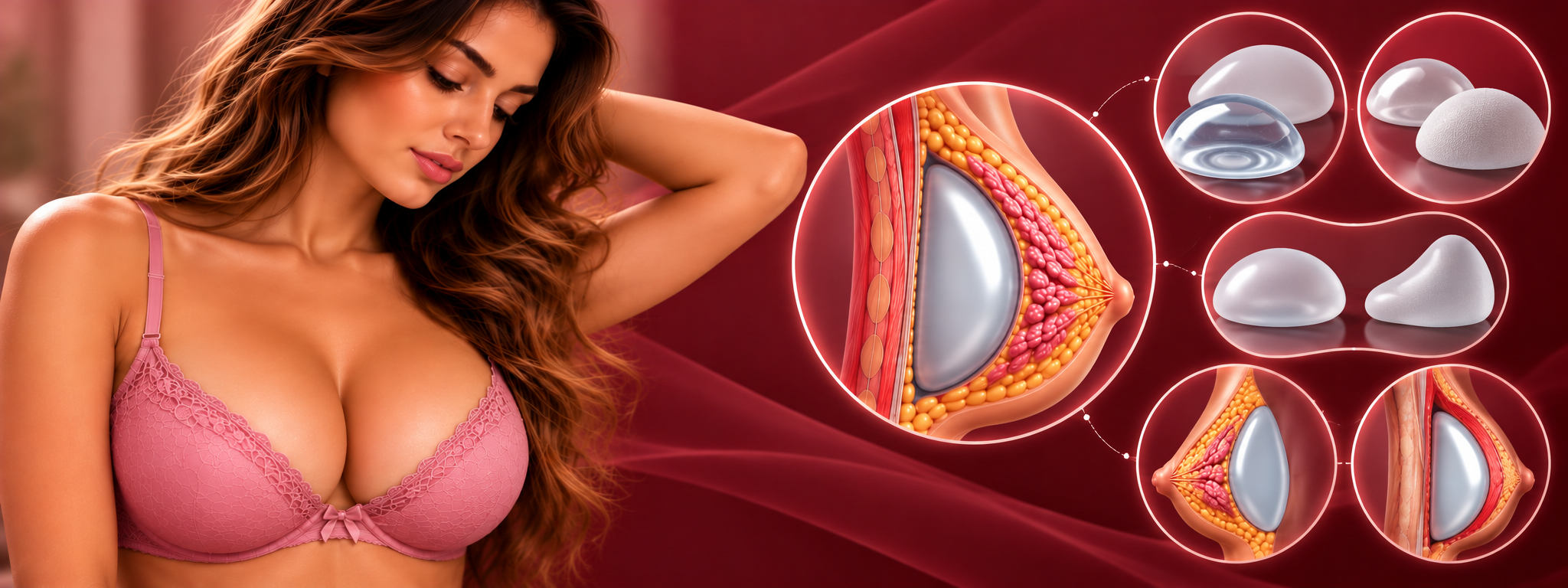
Implant size is not just a number of cubic centimetres. Width, projection and volume interact, and the right balance depends on your chest and soft tissue.
Volume is measured in cubic centimetres (cc). It describes how much the implant holds, not how large it will look on you. The same volume can look modest on a wider chest and fuller on a narrower one.
Base width is the measurement across the bottom of the implant. It should fit the width of your breast so that the implant does not extend past the natural base or leave tissue uncovered. A base that is too wide may cause problems at the sides of the breast or under the arm.
Profile describes how far the implant projects forward. Manufacturers use terms such as low, moderate, moderate-plus and high, but these names differ between brands and are not standard.
For a given volume, a higher-profile implant has a narrower base. For a given base, a higher volume usually means more projection. A wide implant on a narrow chest can create problems, high-projection implants may look more obviously augmented in some people, and overly large dimensions raise the chance of stretching, thinning and later surgery.
A written plan should state the implant volume, base width, profile, surface, shape and placement, and explain why those choices suit your measurements. If two plans give the same volume but different widths, the look and the risks are not the same. Ask which measurement drove the decision.
Cup size depends on band size and manufacturer, so it cannot describe an implant. A 300 cc implant may produce different cup sizes on two people. Use cup size to describe your goal, then let measurements guide the choice.
Surgeons measure the breast base, assess tissue pinch and may use sizers. Treat computer simulations as a rough indicator only.
Ask about width and projection, not just cc or cup size. See choosing implant size and the breast implants guide.
Before publication: qualified clinician review and current Indian regulatory verification, where relevant, are required. Sources: FDA: Breast Implants · CDSCO: Medical Device & Diagnostics.
Continue reading
Return to the full category guide.
Candidacy, risks and when to seek medical help.
Study findings, limitations and original publications.
Why cup size is unreliable and how volume is assessed.
The wider guide to implant choices.
How the pocket and muscle affect the final look.