Non-Surgical Breast Enlargement
Return to the full category guide.
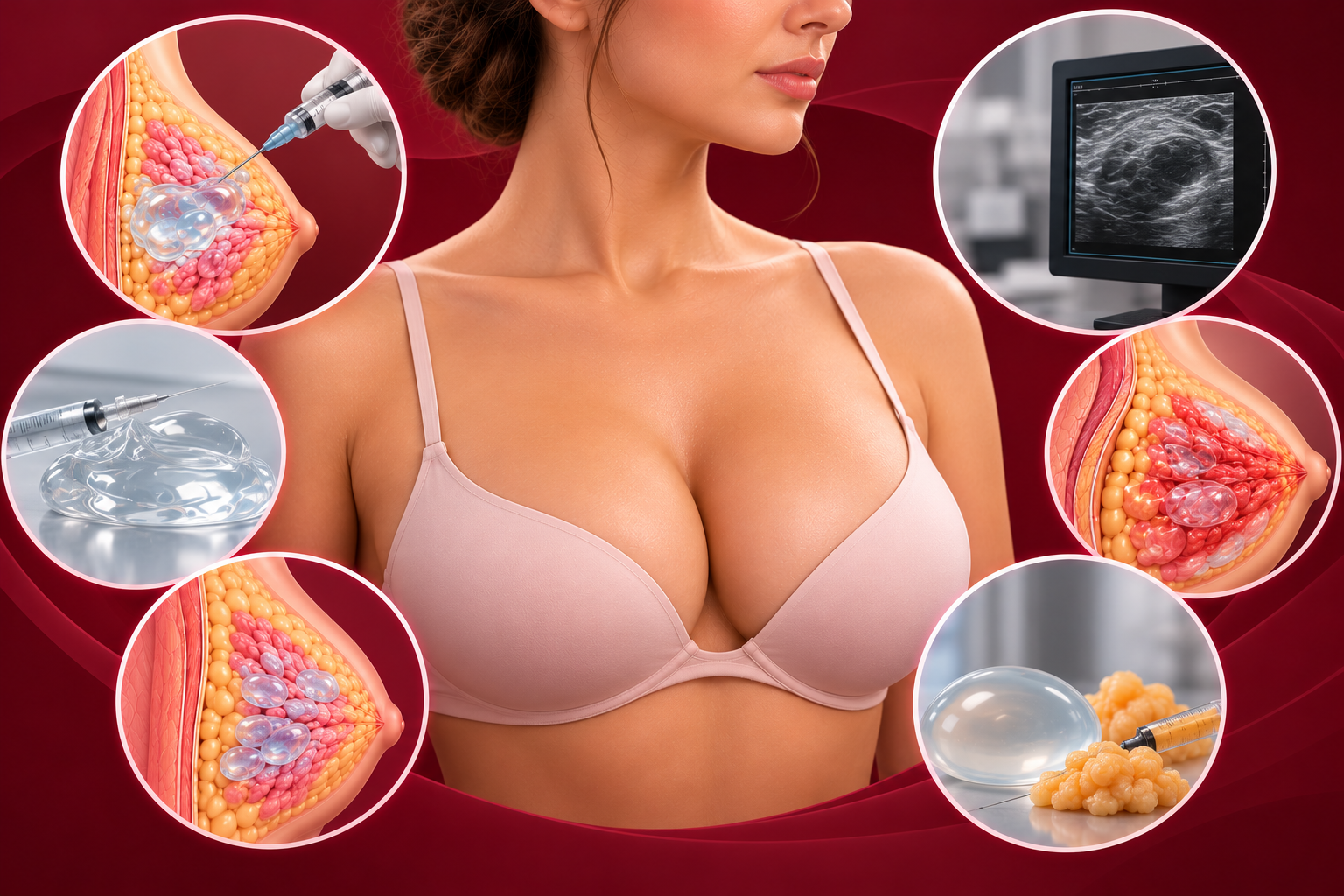
Hyaluronic acid (HA) is a substance found naturally in the body that attracts and holds water. HA fillers are gels made from a modified form, injected to add volume or fill lines. This page is part of our guide to breast fillers.
The gel sits under the skin and adds volume directly, and it binds water. The body gradually breaks it down, so effects are temporary, commonly lasting months to a couple of years depending on the product and area.
Approvals vary by product and country, but typically include facial areas such as lips, cheeks, nasolabial folds and under-eye hollows, and in some cases hands. Approval is based on studies in those areas.
Breast tissue is much larger, softer, and more complex. Studies supporting facial use do not show safety or effectiveness in breast enlargement. A product may be sold in a country but still not be approved for breast use.
HA fillers can be broken down by an enzyme called hyaluronidase, which is one of their advantages. This applies only to HA products and does not apply to other filler materials. Even when a product can be dissolved, large-volume injections can leave inflammation, lumps or contour problems that need further treatment.
Other fillers use different materials, such as calcium hydroxylapatite or poly-L-lactic acid, with different behaviours. Some are semi-permanent or permanent.
Fillers approved for the face are not proven for breast use.
Continue reading
Return to the full category guide.
Candidacy, risks and when to seek medical help.
Study findings, limitations and original publications.
The parent guide to evidence, regulation and safety.
Lumps, infection, migration and other risks.
How fillers compare with fat transfer and implants.